
...You're not alone.
I keep hearing the same complaints from nursing and nothing changes."
The metrics I'm accountable for are not moving despite the group's promises."
We're looking for stronger physician engagement during multidisciplinary rounds."
Quality scores are affecting reimbursement and I can't get traction on fixing them."
Nursing and the physician group are in constant conflict and I'm caught in the middle."
The group is meeting their contract requirements. Nothing more."
...You're not alone.
I keep hearing the same complaints from nursing and nothing changes."
The metrics I'm accountable for are not moving despite the group's promises."
We're looking for stronger physician engagement during multidisciplinary rounds."
Quality scores are affecting reimbursement and I can't get traction on fixing them."
Nursing and the physician group are in constant conflict and I'm caught in the middle."
The group is meeting their contract requirements. Nothing more."

Performance and Quality Frustration
Metrics aren't moving. Complaints keep coming. These are not the same problem.
When performance has stalled and the answers you're getting aren't fixing anything.
You know numbers aren't where they should be...
You’ve had the conversations. The group’s leadership agrees, explains, and provides context. Some of it sounds great. Some of it sounds like a way to move past the meeting without committing to anything.
The missing piece.
Hospital performance challenges rarely stem from a lack of dedicated clinicians. More often, they reflect a shortage of clinical leadership—leaders who can evaluate workflows, interpret data, engage physicians and staff, and recognize the difference between a process that needs redesign and a team that needs support.
CVCCM was intentionally built for this role. We provide clinical coverage while partnering with hospitals to improve operations, strengthen physician leadership, and achieve lasting results.
That perspective isn’t developed from a corporate office or management report. It comes from physician executives who have cared for patients at the bedside, led clinical teams, worked within the systems they’re improving, and understand not only what the data shows, but why it behaves the way it does.
Our Solution
We don’t arrive with a national playbook full of templates. Before anything is prescribed, the situation is diagnosed. What’s causing your metrics to move the way they do? What workflows and behaviors are driving those results? And who has the ability to change them?
Those answers aren’t found in dashboards alone. They come from physician leaders who are present in the rounds, engaged in the data, and willing to have the difficult conversations that meaningful improvement demands.
When the underlying operational challenge is addressed, improvement extends far beyond a single metric. Rather than chasing individual performance measures, we focus on strengthening the systems that produce them. As those systems improve, performance follows across multiple areas simultaneously.
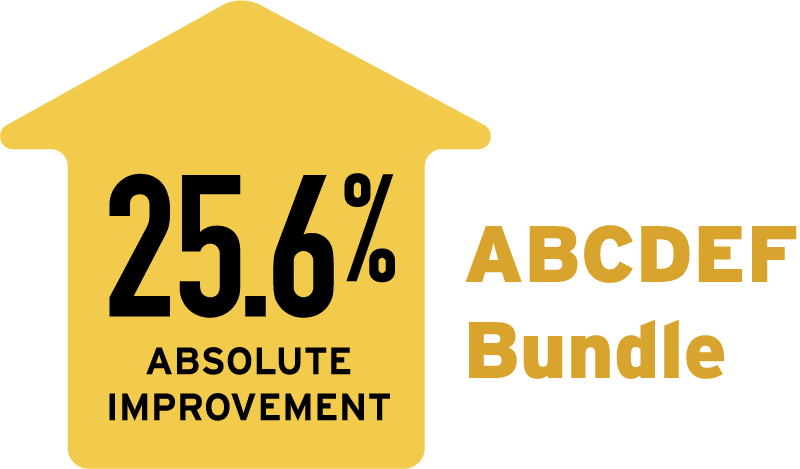
This is how we help hospitals recover, stabilize, and sustain meaningful improvement—by building systems that reinforce physician leadership, accountability, and engagement long after implementation. After assuming ICU leadership on June 1, 2024, CVCCM led a rapid performance transformation, advancing past 19 peer hospitals in just nine months to achieve the #1 ranking in ABCDEF Bundle compliance across one of the nation’s largest healthcare systems.
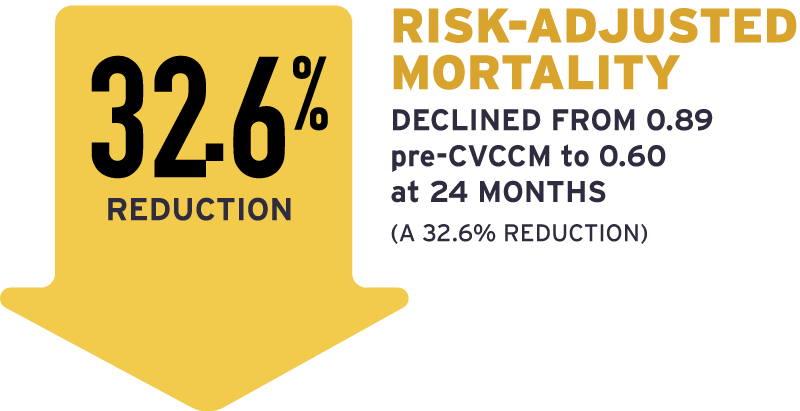
During this same period, ICU observed-to-expected (O:E) mortality declined by 24%, and risk adjusted mortality by 32.6%, demonstrating that improvements in operational performance were accompanied by meaningful improvements in patient outcomes.
Because we focus on the underlying system rather than isolated metrics, improvements often occur across multiple areas at the same time. Length of Stay (LOS), CPOE compliance, CLABSI attribution, ED throughput, and other operational measures improve because the culture, workflows, and physician leadership supporting them have changed.